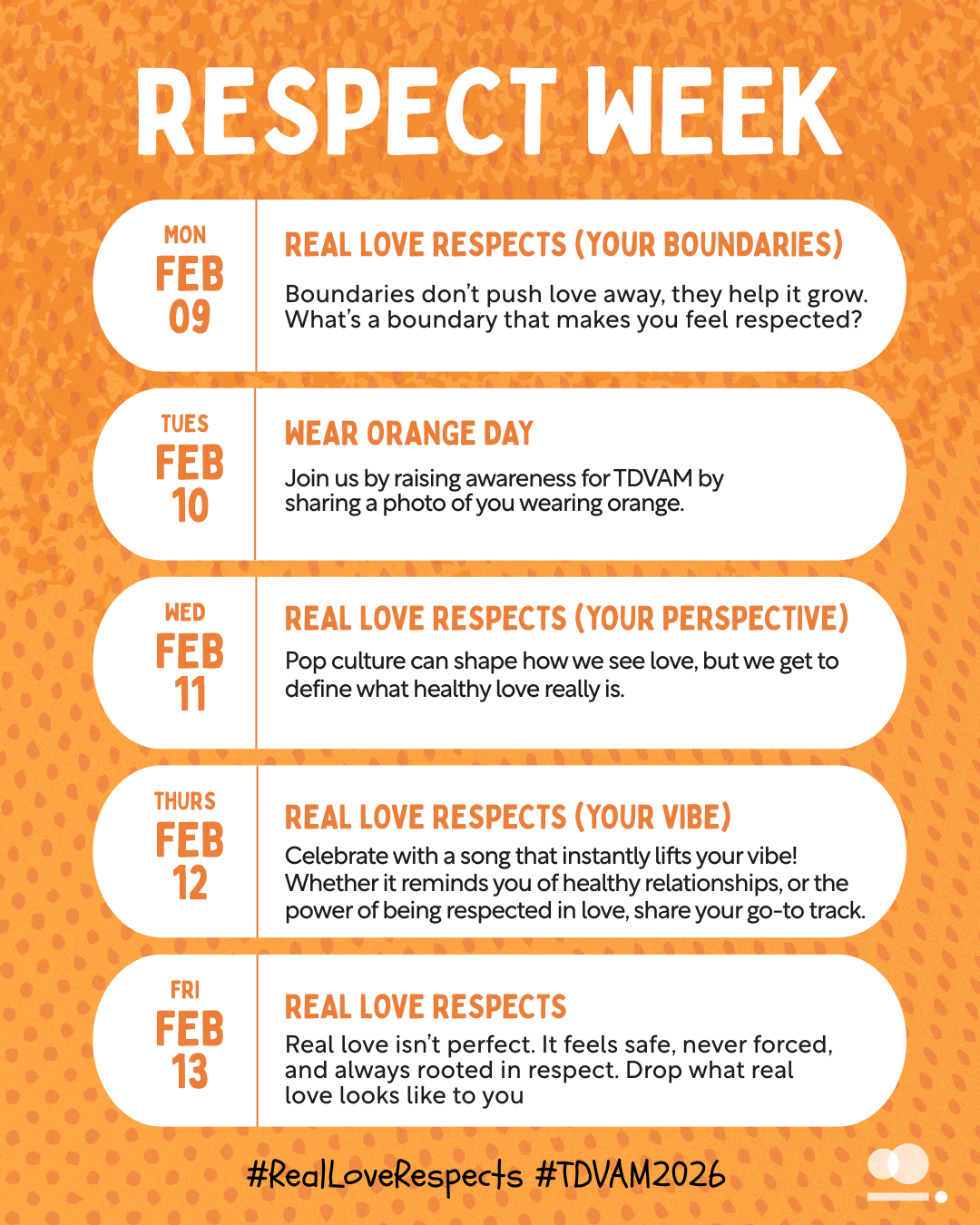
February is Teen Dating Violence Awareness Month!

Teen Dating Violence Awareness Month: Education, Prevention, and Support for Our Community

February marks Teen Dating Violence Awareness Month (TDVAM), a time to shine a light on the realities of teen dating violence and reaffirm our commitment to keeping young people safe through education, prevention, and support.

At Bridge of Hope Child Advocacy Center, we know that healthy relationships are learned. By providing trauma-informed prevention education and community outreach across Southwest Nebraska, we work to help teens recognize unsafe behaviors, understand their worth, and build relationships rooted in respect and consent.

What Is Teen Dating Violence?

Teen dating violence is a pattern of behaviors used to gain power or control over a dating partner. These behaviors may include:

  • Emotional or verbal abuse (insults, manipulation, intimidation)

  • Physical abuse (hitting, pushing, restraining)

  • Sexual abuse (pressure or coercion into sexual activity)

  • Digital abuse (constant monitoring, excessive texting, sharing private images)

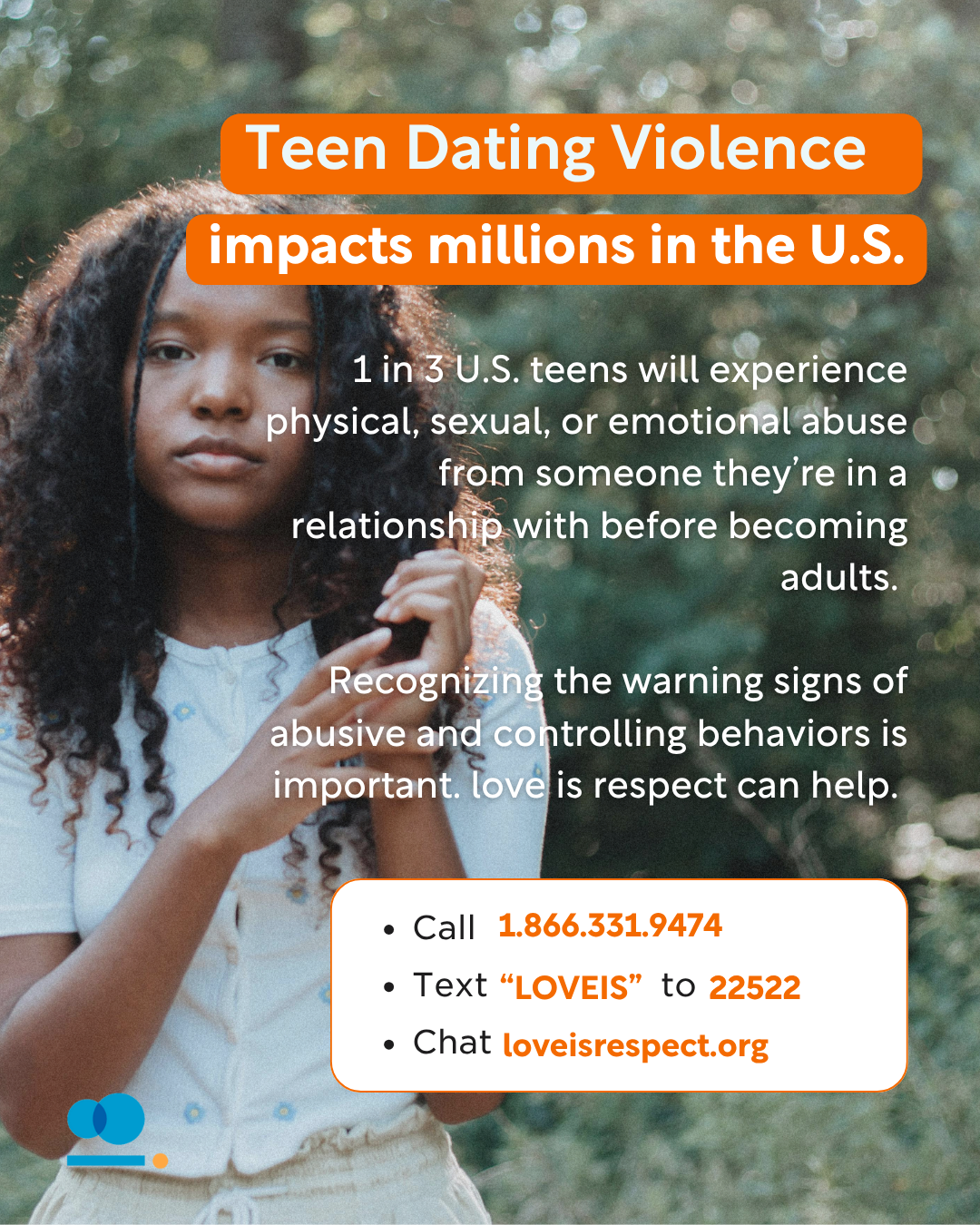
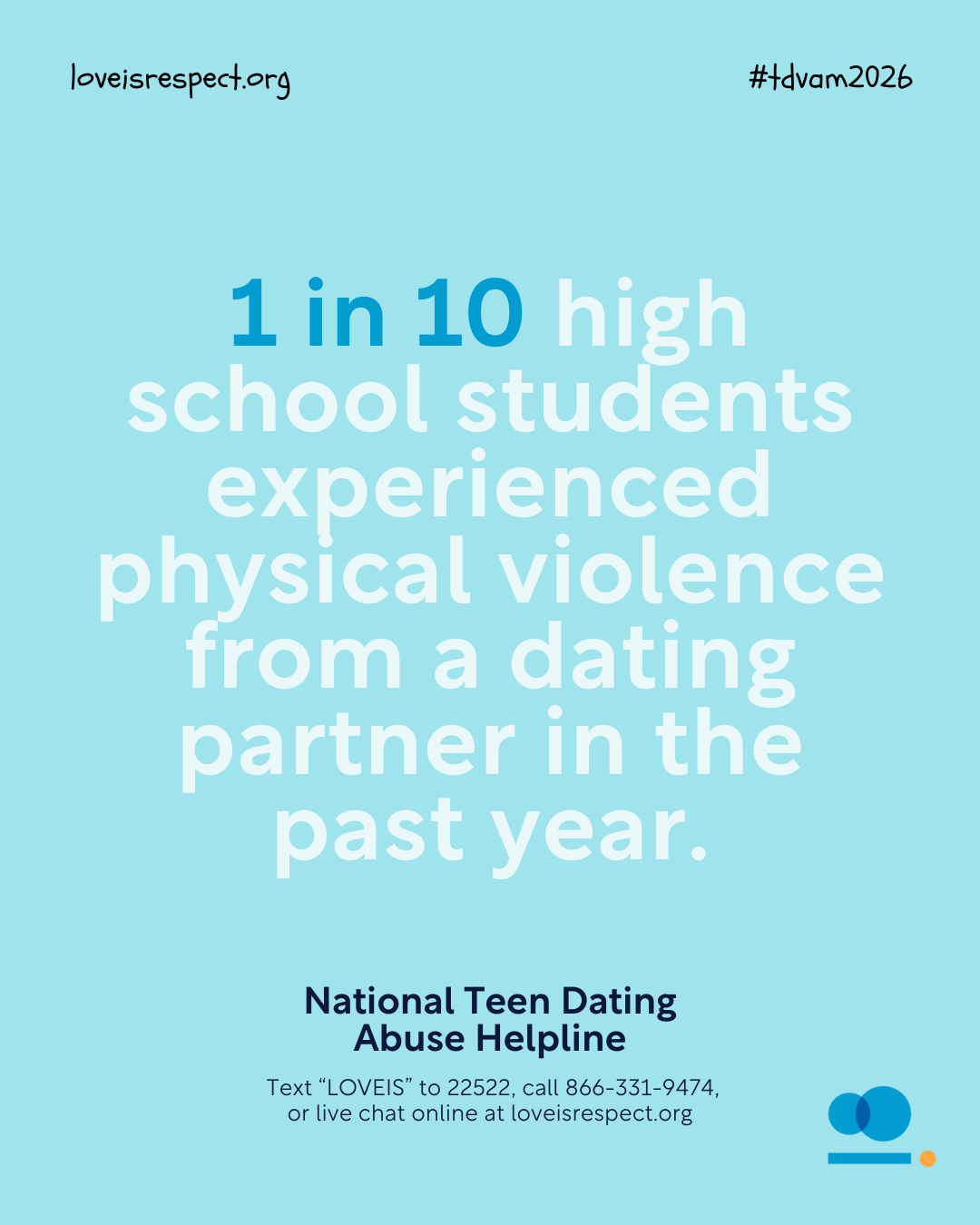
According to the Centers for Disease Control and Prevention (CDC), 1 in 3 teens in the United States experiences some form of dating abuse. Many teens don’t report abuse because they may not recognize the behavior as unhealthy or fear they won’t be believed.

Why Awareness and Prevention Matter

Teen years are a critical time for forming beliefs about relationships. Without education and support, harmful behavior such as jealousy, control, or pressure can be mistaken for love or normal conflict.

Through prevention education, school presentations, and community outreach, Bridge of Hope helps teens and trusted adults learn:

  • The difference between healthy and unhealthy relationships

  • Warning signs of abuse

  • How to set boundaries and communicate safely

  • Where to turn for help

Prevention isn’t just about stopping abuse, it’s about empowering youth with skills that last a lifetime.

Our Role at Bridge of Hope Child Advocacy Center

Bridge of Hope Child Advocacy Center provides trauma-informed services for children and families impacted by abuse and neglect, while also focusing on prevention and early intervention. We partner with schools, professionals, and community members to deliver education that promotes safety, resilience, and awareness.

During Teen Dating Violence Awareness Month and throughout the year, we are committed to creating safe spaces for learning, conversation, and healing.

What to Do If You’re Worried About a Teen

If you’re concerned about a teen who may be experiencing dating violence, your support can make a difference.

  • Listen without judgment. Let them share at their own pace.

  • Validate their feelings. Avoid minimizing their experiences.

  • Don’t pressure them to “just leave.” Leaving can be complicated and scary.

  • Encourage connection to trusted support. This could include a parent, school counselor, advocate, or local resource.

  • Know when to get help. If there is immediate danger, contact emergency services.

Even small actions like checking in, offering resources, or being a consistent, safe adult can have a powerful impact.

You’re Not Alone: Helpful Resources

Nebraska Resources

  • Nebraska Domestic Violence Sexual Assault Coalition (NDVSAC)
    🌐 ndvsac.org

  • Nebraska Statewide Domestic Violence Hotline
    📞 1-800-572-7233

  • Bridge of Hope Child Advocacy Center
    Trauma-informed advocacy, prevention education, and support for children and families
    🌐 bridgeofhopecac.org

  • Nebraska Child Abuse & Neglect Hotline
    📞 1-800-652-1999

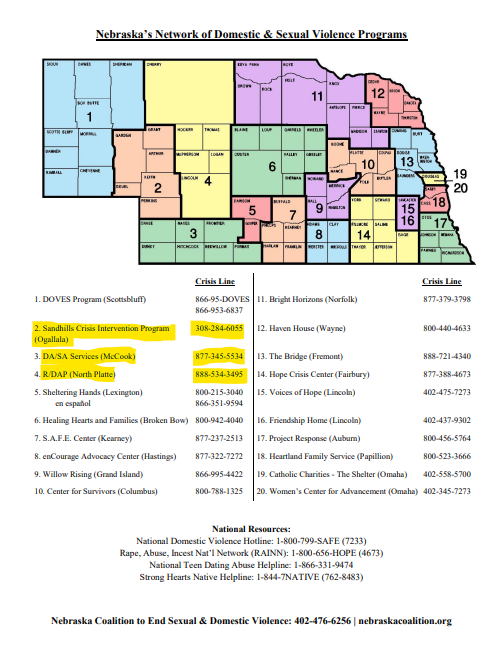
  • Nebraska Coalition To End Sexual and Domestic Violence

  • R/DAP (North Platte Area) (Rape and Domestic Abuse Program)

    • RDAP’s crisis hotline is available 24 hours a day by calling 308-534-3495, texting 308-536-4848, or via online chat

  • SCIP (Ogallala area) (Sandhills Crisis Intervention Program)

    • 24-Hour Crisis Line:  308-284-6055

  • DASAS (McCook Area)

    • crisis line: 877-345-5534

National Resources

  • Love is Respect
    📞 1-866-331-9474 | Text LOVEIS to 22522
    🌐 loveisrespect.org

  • One Love Foundation
    Healthy relationship education for teens and young adults
    🌐 joinonelove.org

  • National Domestic Violence Hotline
    📞 1-800-799-7233 | Text START to 88788
    🌐 thehotline.org

Moving Forward Together

Teen Dating Violence Awareness Month reminds us that prevention starts with education, compassion, and community involvement. By working together, we can help teens recognize their value, build healthy relationships, and know they are never alone.

To learn more about Bridge of Hope’s prevention programs or how to get involved, please visit our website or contact us directly.
January is Human Trafficking Awareness Month

Every January, communities across the country observe Human Trafficking Awareness Month—a time to shine a light on a crime that often hides in plain sight and to empower individuals with the knowledge to help keep children, teens, and adults safe.

Human trafficking is not just something that happens “somewhere else.” It occurs in cities, suburbs, and rural communities alike. It affects people of all backgrounds, and it often begins with vulnerability, manipulation, and unmet needs. The good news is that awareness saves lives - and prevention starts with each of us.

What Is Human Trafficking?

Human trafficking involves the use of force, fraud, or coercion to exploit a person for labor or commercial sex. When a minor is involved in commercial sex, it is considered trafficking regardless of force or coercion.

Traffickers may present themselves as friends, romantic partners, employers, or mentors. Over time, they build trust and dependency before exploiting it.

Who Is Most at Risk?

Anyone can be targeted, but certain factors can increase vulnerability, especially for children and teens. These may include:

  • Prior abuse or neglect

  • Family conflict or instability

  • Running away or homelessness

  • Social isolation or unmet emotional needs

  • Excessive unsupervised online activity

Recognizing vulnerability is not about blame, it’s about identifying opportunities for early support and protection.

Warning Signs to Watch For

Human trafficking doesn’t always look like what we expect. Some possible red flags include:

  • Sudden changes in behavior, appearance, or relationships

  • An older or controlling boyfriend/girlfriend

  • Unexplained gifts, money, or new items

  • Withdrawal from family, friends, or activities

  • Fearfulness, anxiety, or scripted responses

  • Excessive secrecy about online activity

Seeing one sign does not automatically mean trafficking is occurring, but patterns and concerns should never be ignored.

Prevention Starts With Connection

One of the most powerful prevention tools is healthy, safe relationships. Children and teens who feel supported, believed, and valued are less likely to be exploited—and more likely to seek help when something feels wrong.

You can help by:

  • Keeping open, judgment-free conversations with children and teens

  • Talking about online safety and healthy relationships

  • Knowing who your child is spending time with—both in person and online

  • Trusting your instincts and taking concerns seriously

What to Do If You’re Concerned

If you believe someone may be at risk or experiencing trafficking:

  • Reach out to a trusted local resource, such as a child advocacy center

  • Report concerns to local law enforcement or child protective services when appropriate

  • Contact the National Human Trafficking Hotline at 1‑888‑373‑7888 or text 233733 (BEFREE) for confidential guidance and support

  • 24/7 Hotlines & Immediate Help

    • Nebraska Human Trafficking Hotline:

      • Call 833-757-5665 to report suspected trafficking in Nebraska — tips go directly to law enforcement and trained responders. ago.nebraska.gov

    • Nebraska Coalition To End Sexual and Domestic Violence

    • R/DAP (North Platte Area) (Rape and Domestic Abuse Program)

      • RDAP’s crisis hotline is available 24 hours a day by calling 308-534-3495, texting 308-536-4848, or via online chat

    • SCIP (Ogallala area) (Sandhills Crisis Intervention Program)

      • 24-Hour Crisis Line:  308-284-6055

    • DASAS (McCook Area)

      • crisis line: 877-345-5534

You do not need proof to ask for help—concerns alone are enough to start a conversation.

A Community Responsibility

Human trafficking prevention is not the responsibility of one agency or profession, it belongs to all of us. When communities are informed, connected, and proactive, traffickers lose the secrecy they rely on.

This Human Trafficking Prevention Month, let’s commit to learning the signs, strengthening protective factors, and speaking up when something doesn’t feel right. Together, we can create safer futures and protect the most vulnerable among us.

If you’d like to learn more about prevention, education, or services available in our community, we invite you to reach out to our team. Awareness is the first step, action is the next.

📘 Online Educational Resources on Human Trafficking Awareness & Prevention

  • Blue Campaign- Blue Campaign works closely with DHS Components to develop general awareness trainings, as well as specific educational resources to help reduce victimization within vulnerable populations.

  • Polaris – Human Trafficking 101 — A free, interactive online training that explains what trafficking is, how it happens, who is at risk, and actions individuals can take. Polaris

  • TraffickWatch Academy (The Exodus Road) — Short online learning modules designed for community members, activists, and responders to learn facts and take action. Traffickwatch+1

  • kNOw MORE Resource Center — Curated resources, tools, and educational materials for awareness and prevention efforts. Human Trafficking Coalition

  • GUARD Against Trafficking – Education & Awareness — Explains trafficking in clear terms and includes resources like glossaries, warning signs, and prevention education. GUARD Against Traffi

  • LifeWay Network Resources — Free downloadable guides, simulations, and awareness tools for individuals, educators, and students. LifeWay Network

  • TRAFFICKSTOP Toolkit (IACP) — A curriculum and toolkit for schools and community groups to teach human trafficking identification and prevention. IACP

  • Teach Against Trafficking – Educational Materials — Toolkits and youth-friendly materials to help schools and groups raise awareness and educate students. Teach Against Trafficking

  • Our Rescue – Training & Prevention Courses — Free online courses that introduce basic trafficking concepts, warning signs, and what we can do to help prevent it. Our Rescue

  • National Human Trafficking Training & Technical Assistance Center (NHTTAC) — A broad library of training materials, webinars, factsheets, and professional development resources. NHTTAC

  • IRC Anti-Trafficking Educational Videos — A collection of short videos explaining different aspects of trafficking and providing foundational knowledge. IRC Anti-Trafficking Response

map of domestic and sexual abuse programs


April is Child Abuse Prevention Month!

Kicking Off Child Abuse Prevention Month: Protecting Our Children, Strengthening Our Community

Every April, communities across the nation come together to recognize Child Abuse Prevention Month—a time dedicated to raising awareness, supporting families, and committing to the safety and well-being of all children. This month-long observance is a powerful reminder of the role each of us plays in protecting children and strengthening families.

Why Child Abuse Prevention Month Matters Child abuse and neglect are serious issues that impact millions of children each year, leaving lasting scars on young lives. According to the U.S. Department of Health & Human Services, an estimated 3.9 million child maltreatment reports were received in a recent year, involving more than 7 million children. Tragically, five children die each day from abuse and neglect. Prevention requires a community effort—when families are supported, children are protected. By working together to promote safe, nurturing environments, we can help children thrive.

Get Involved: Events and Activities This April, we invite you to participate in events and initiatives designed to raise awareness and offer support to families in need. From educational workshops and seminars to family-friendly gatherings and volunteer opportunities, there are many ways to make a difference. The bridge of Hope CAC as well as many other phenomenal organizations have great events going on all month long. Stay connected with us throughout the month on out Facebook page for event announcements and ways you can get involved.

Together, We Can Make a Difference Protecting children and supporting families is a shared responsibility. Small actions—like checking in on a neighbor, offering support to a parent, or getting educated on the signs of abuse and neglect—can create safer communities for all. Join us this month as we stand united against child abuse and work toward a future where every child feels safe, loved, and supported.

Let’s make a commitment this April to speak up, show up, and make a difference. Together, we can protect children and build a stronger, more supportive community for all.

If you would like a yard sign like these ones, give us a call! 308-534-4064